


change is in the air - a week of firsts

It seemed in the realm of forever since rain had fallen on our parched land. We have been keeping weather records since 1998, and they served us well over the years. I cannot tell you how many times I have said "This has never happened before", but according to our data, had occurred.
As of the 13th of September, our total moisture for the year of 2026 (since January) was 4.76 inches. It was the driest summer here we had recorded. Due to the changing climate and warming of the Pacific Ocean (people were actually able to swim comfortably in the ocean off of southern California), hurricanes are forming with increasing frequency off Baja California, Mexico, and are steered by winds aloft toward coastal California and Hawaii. And when that happens, moisture from the storms is pumped up into California, Arizona, and New Mexico, which is occurred during the past two weeks, rendering almost 7 inches of rain here in Santa Fe. That was a first since we have been keeping records. It also moved the pitiful moisture total from 4.76 to 11.71. Just like that, September became the wettest September on record. It was also the wettest single month on record in Santa Fe since 1855.
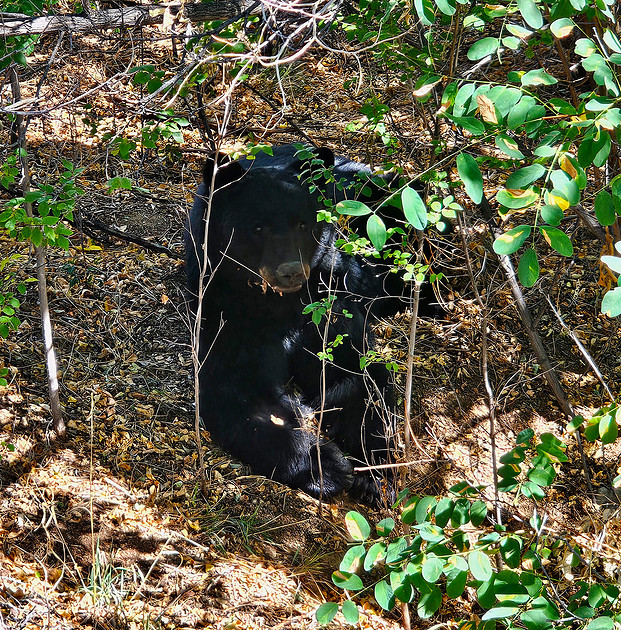
Several other "firsts" have happened in our neighborhood as well. People throughout the western United States have inadvertently been "hosting" bears since they emerged from hibernation this year. Pet food, bird feeders, water dishes called to them and members of the Ursid family heeded the call. Neighbors less than half a mile from us spotted one several weeks ago in an arroyo a tenth of a mile from their house. Thanks to our friend, Gustavo, who shot a photograph of "Father Bear" with his phone, you can see him here.
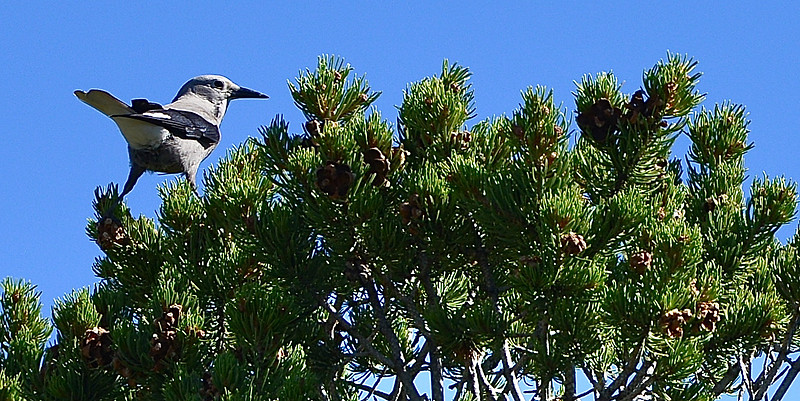
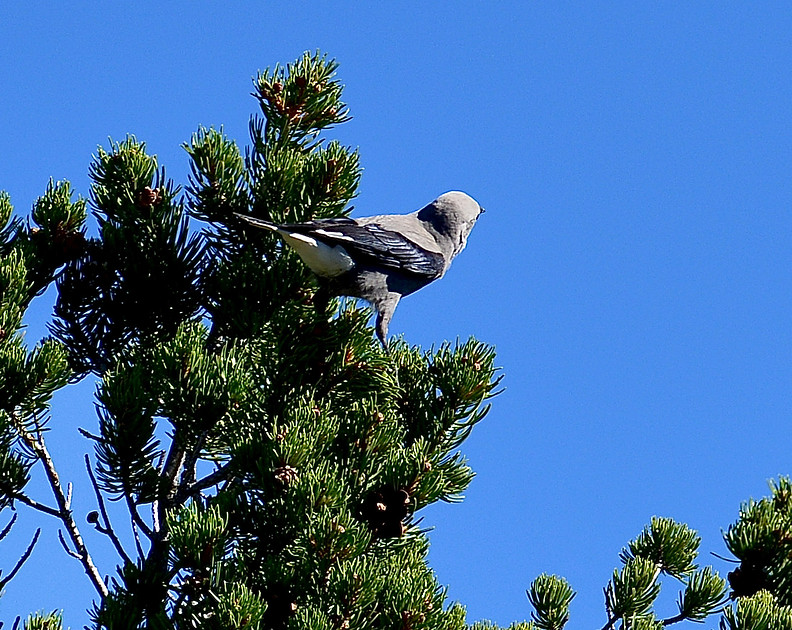
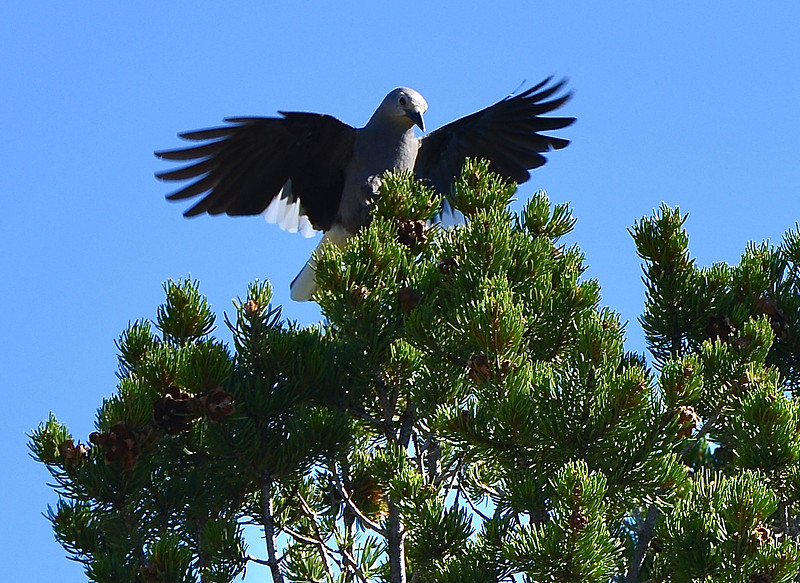
Another first - flocks of Clark's nutcrackers (named after William Clark of the exploring team Lewis and Clark) first thought the bird was a type of woodpecker because of the long beak. In body shape, they resemble other members of the Corvid family (jays, crows, ravens, and magpies), but their markings of black, grey, and white distinguish them from the others. Note the white patch on the rear wings of the bird in the images below.
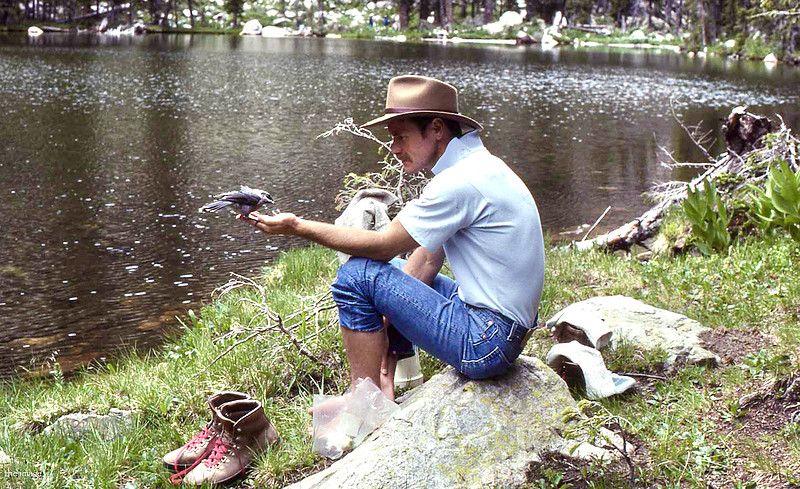
Our first encounter with a Clark's was on a hike to Nambe' Lake. One of them seemed to be hanging around us, so Fred put some nuts in his hand. It wasn't five minutes before one landed on it and took a nut. And then another. And another. Below is an old image from that hike in the 1990s.
Another year while on the Winsor Trail near the Ski Santa Fe, we ran into a couple of hikers along the trail. They were resting and having a snack. She told us how she had just unwrapped some food and a Clark's immediately flew down to see if she would share. And she did.
Like all Corvids, Clarks have great eyesight and obviously, acute hearing. I don't know when these particular birds adapted to people. but they definitely know that humans can provide food. They use a specialized sublingual pouch under its tongue to transport up to 90 seeds at a time. (Montana Public Radio). Apparently, one bird can hide 30,000 or more seeds in the autumn for winter feeding and find 90% of them. It makes me wonder if they have stashed piñon in trees here.
The Clark's nutcracker shown below is preparing to land and work on the piñon nuts in the tree. Nuts and seeds are the nutcrackers' food of choice. So if you see birds with the patchwork of black, grey and white at this time of year, they are Clark's who have, for some reason, (and for the first time we know of) flying around neighborhoods where piñon trees are common, you will know what they are. The fact they they are here is not normal.
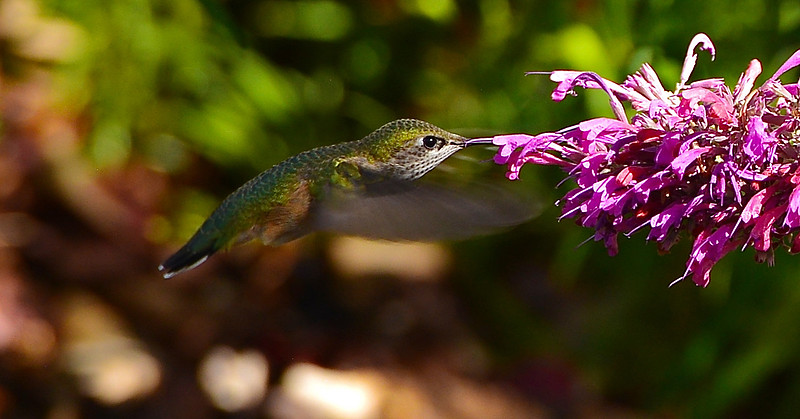
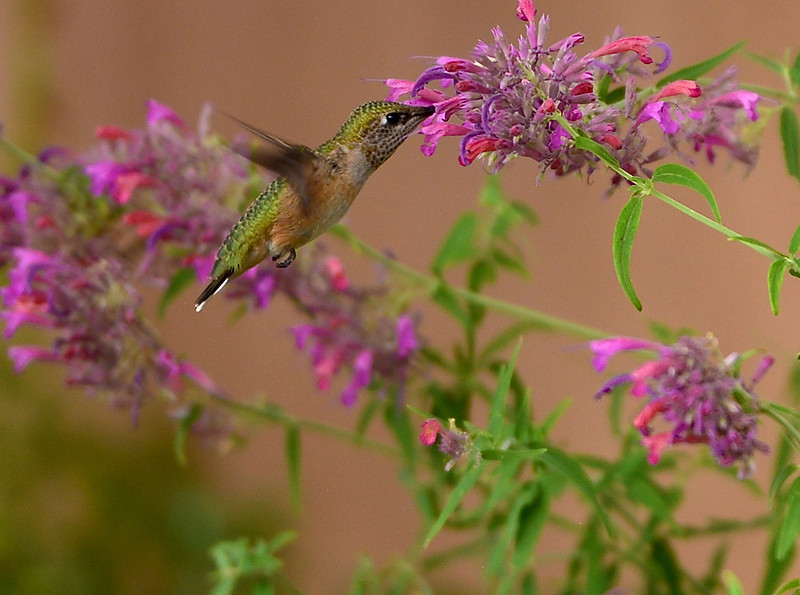
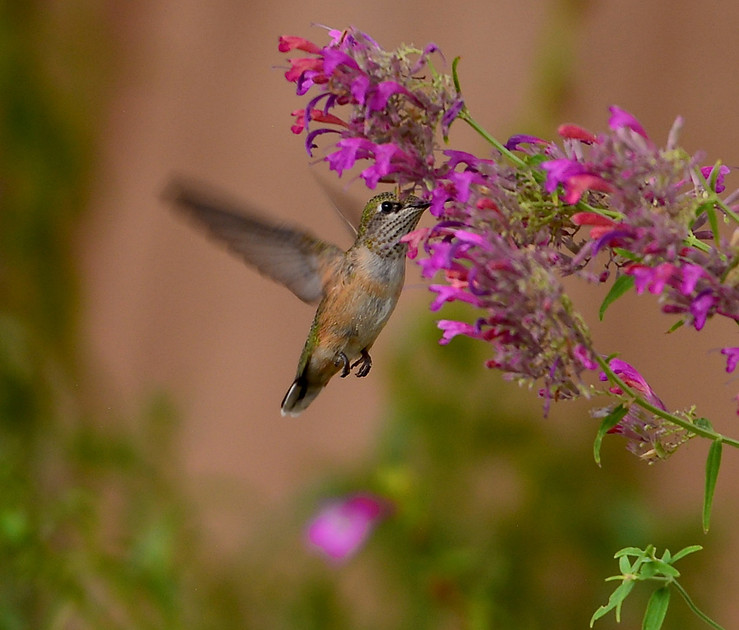
Another first and the third in my list of "first" is the length of time the hummingbirds have remained in the neighborhood. It pleases me no end to have these flying wonders in residence into October, but it worries me. We have yet to have our first frost of the season, and hopefully, they will not get caught before migrating south. As long as plants like the Desert Sunrise Agastache still have blooms on them, the hummers will stay.
The reason I went into photographic and written detail on these "firsts", is that they are most likely indicators of climate change. Being a biology minor at UNM in the early 70s, many of the courses I took involved ecology and climate change. As an architecture major, Fred also was in the thick of solar design and engineering. We can remember instructors warning us of what would happen to the earth if humans kept on their current path. Here we are, 50+years on, and these subjects are once again coming to the fore, particularly concerning water quality and availability. Many people worldwide already fall into the category of "environmental refugees". Although wise people over time have said "hope is not a plan", I will hope real solutions (not pie-in-the sky shiny objects) including conservation (which is truly the best solution to climate change) are not only seriously considered but implemented. It is neither easy nor straight forward, as the Iran war and the closing of the Strait of Hormuz and the Bab Al-Mandeb Straits demonstrate, but require political will and the courage of humans to help.
Photographic notes
I photographed the Clark's Nutcrackers with my Nikon D800 and 70-200 mm lens, at probably the least desirable time of day between 11 and 11:30 a.m under fairly harsh light. Since their presence was a first, it prompted me to shoot regardless of the conditions. If they continue to be residents in the neighborhood, I will do at least another session, hopefully under better light. However, a photographer must take what she or he can get, and go with it, for documentary purposes.
The hummingbirds were a bit easier because I could photograph them almost any time of day in strong but shaded light. Still, with both types of birds, photographing them with a long lens, provided ample isometrics.
Thanks to Tim, Gustavo, Victoria, Rebeccas, M. F. B., Steve, Jean & Sam, and Marilyn G. to getting in touch last week. With luck, the photographers out there will have an opportunity to do some camera isometrics while capturing nature in its finest this week!
until next Monday,
DB
a passion for the image©