


the practice of art

More than once in my years of blogging, I have addressed the practice and process of art - how practicing artists and craftspeople work, how they organize their time, among other things, and how they deal with a more or less solitary practice. For some, it is almost meditative, like being cloistered and completely involved in their work. A current exhibit at the New Mexico Museum of Art in Santa Fe, "Gustave Baumann: The Artist's Environment" features the work of Gustave Baumann, a man known for his printmaking, but whose work was all encompassing. His creative brain experimented with almost every medium - from printmaking, metal and wood sculpture and other carving, including marionette building, and painting, all frequently done with humorous touches. We recently spent nearly three hours pouring over different elements of the exhibit with our friend, Sara McCook Woodburn, who is also a fine printmaker. I have always admired Baumann's prints but have never seen so many in one place at a time. Being with Sara during the process was like having our own personal guide to the art.
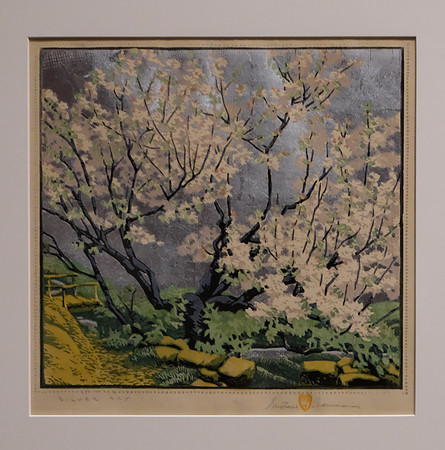
I begin with a photograph of an image that appears in my mind when thinking of Baumann. "Silver Sky", made in 1935, includes paper on which the sky is achieved by applying aluminum leaf to the paper used for the print. It provides the backdrop for the print itself. As in photography, the backdrop is crucial to a finished print.
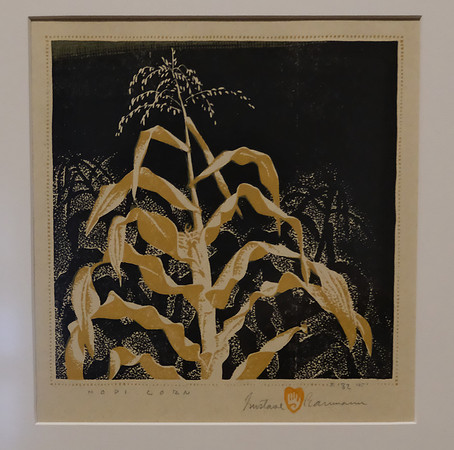
"Hopi Corn" made in 1938 is almost black and white in feel, while still very much being a color print.
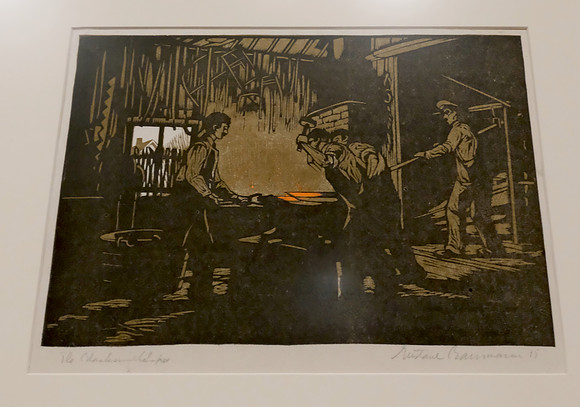
Another example of near-black and white in a color print is one of the earlier Baumann prints, "At the Forge" (with an alternate title "The Blacksmith Shop") 1910/1914. It is almost like the selective coloring of a black and white photograph, with the artist choosing to make the heated iron and flecks of fire the only bright colors in the print.
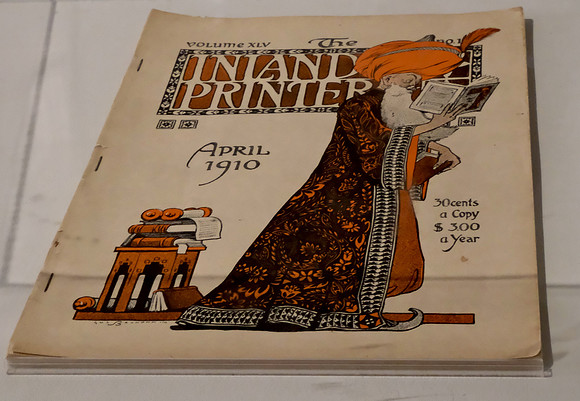
All artists need a source of income, and Baumann was no exception. His work as an illustrator is not as well known, but a cover of the April 1910 edition of The Inland Printer reflects some of that work.
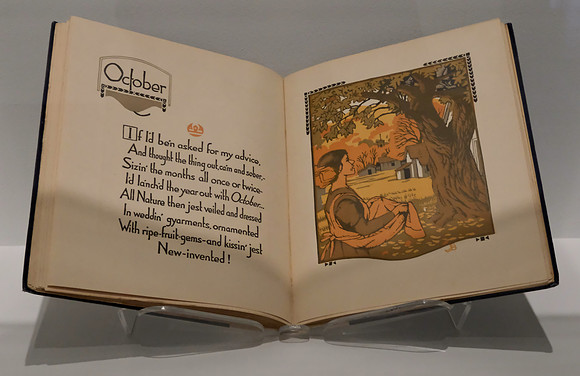
According to the Museum's display, "James Whitcomb Riley, an Indiana native, was the most revered poet of his day, and Baumann, then living in Nashville, was commissioned by the Bobbs-Merrill Company to illustrate his poem All the Year Round. The book featured color scenes of daily life in the rural county, one for each month." This print/illustration was done in 1912, and to me, carried with it the motifs of the Secession and Arts and Crafts movement that enveloped art, architecture, furnishings and fabric of the period. Like the seemingly spontaneous generation of flat bread throughout the world, these arts movements cross-pollinated heavily in Europe and America.
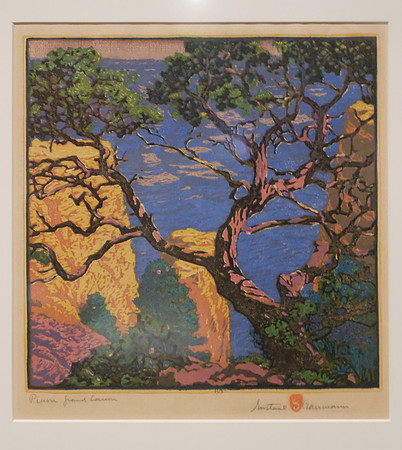
Being the prolific creator that he was, Baumann's subject matter was endless. His prints not only included garden and city themes, but broad landscapes as well, including the two below.
Piñon Grand Canyon, 1921
Pacific Shore Line, 1948
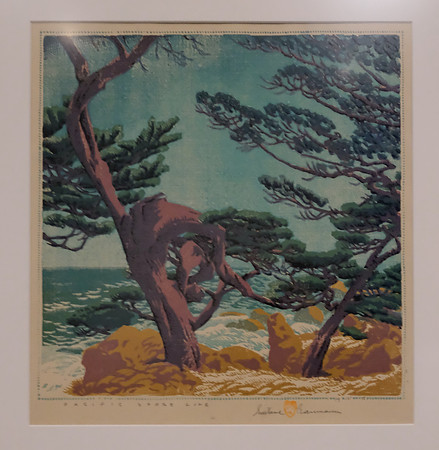
One of the many things that amaze me about Baumann's work is that every point, each stipple and line, has to be carved, and each print has as many as six colors, including black. The colors in all of his work are still quite brilliant, attesting to both the quality of inks and papers used. I did one woodcut and one linoleum print in high school, but using only one color. The complexity of using different colors and really carving for negative and positive space is far beyond my knowledge base.
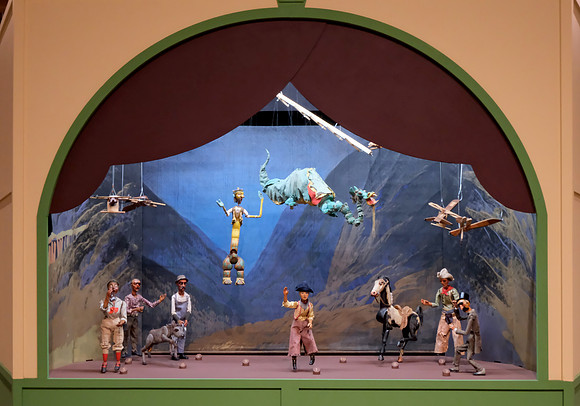
"Golden Dragon Mine", (1932) a puppet show using all the elements of Baumann's work, and including the costumes created by Jane Baumann his wife, is a melodrama of a mine in the Old West. The backdrop is tempera on cloth attached to wooden poles, and each puppet is hand-carved and painted. It is a work in which Baumann's humor shines brightly, with characters such as Oscar the Golden Dragon, Nambe Nell, Lord Leffinghoop, and the Tourist Lady, among others.
"Gustave Baumann: The Artist's Environment" runs through the end of February 2026, at the New Mexico Museum of Arts on Palace Avenue in Santa Fe. It is well worth your time, if you are in the area or planning to make a trip to Santa Fe. General admission tickets are $12.00/each, and $7.00 if you are a New Mexico resident with picture I. D. For more information, click on this link https://www.nmartmuseum.org/visit/
Thanks to Earle, Jean & Sam, Sandra B., Louise W., Steve, Catherine, Terry T., Ingrid, Victoria, Tim, and Lawrence J. for opening December with your comments on last week's blog.
until next Monday,
DB
a passion for the image©
Comments
I think there are displays of his actual print shop in the museum. You probably saw those.