


the beauty of low tech

After twelve days of being without connectivity which meant the lack of publication of one Monday blog, in today's, I turn to the beauty of low tech that requires wood, a few gears, ropes, nuts and bolts, along with strips of machined metal. The Counterbalance Loom has a long history beginning between the 10th and 12th centuries. Fred's loom is a counterbalance loom that had spent a good part of its life in someone's greenhouse, from what we understand. It, most likely, was built by an instructor or group of students at the University of New Mexico campus in El Rito, New Mexico. This particular loom is called a Rio Grande (named for the style of weaving) Walking Loom because the weaver "walks" or puts his or her weight on the treadles in order to open a space through which yarn can be passed from side to side.
Fred uses only two treadles due to the thickness of the Navajo Churro wool with which he weaves. Thinner wool is used in apparel weaving, where generally, more treadles are attached to the loom to produce a finer weave. In the center left of the image below is the front ratchet or gear and the beam on which the finished weaving is rolled. Why the orange sandbag, you ask? There are two that hold the loom in place and keeps it from sliding. Low tech at its finest.
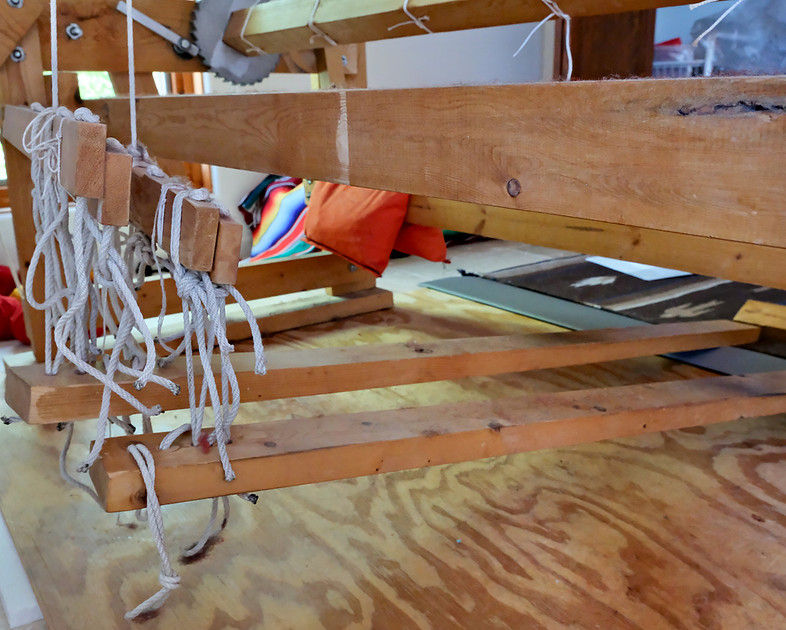 weaving - treadles (two for style he is weaving)
Like some pianists who play barefooted, Fred frequently weaves barefoot or in socks, to have greater connection with and feel for how the loom is moving while he is weaving.
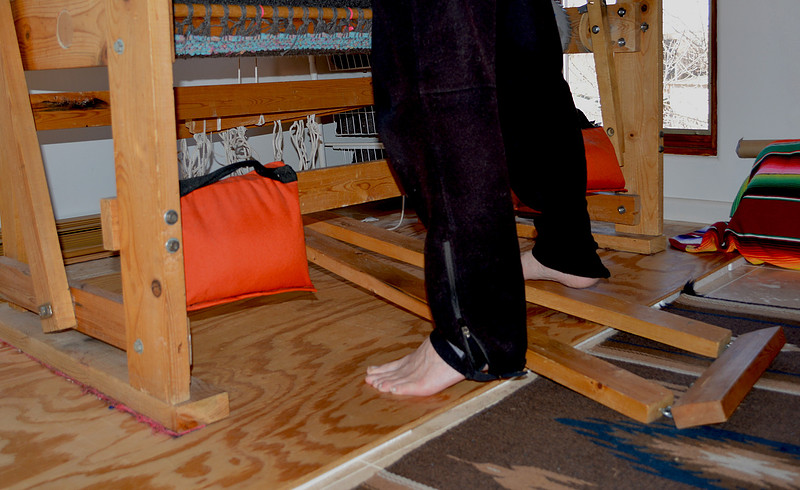 weaving - feet on treaddles
The frame and treadles are built from Ponderosa pine wood, with two large gears - one front and one back - called ratchets. The straight aluminum piece that is bolted onto the frame is a "pawl", which holds the ratchet teeth in place. The two thick steel wire loops shown in front of the ratchet is the reason Fred gets along with the loom so well. They are modifications he made to the original design to keep the wool wound evenly around the back beam. It is a low-tech design that in my eyes, still has a high level of complexity.
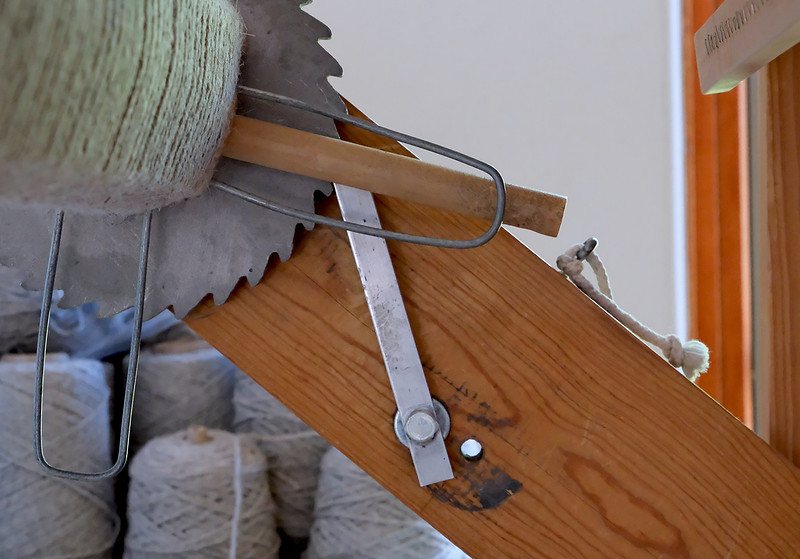 weaving - back ratchet and paul and warp beam with warp wrapped on it
Here is another shot of the back beam and ratchet.
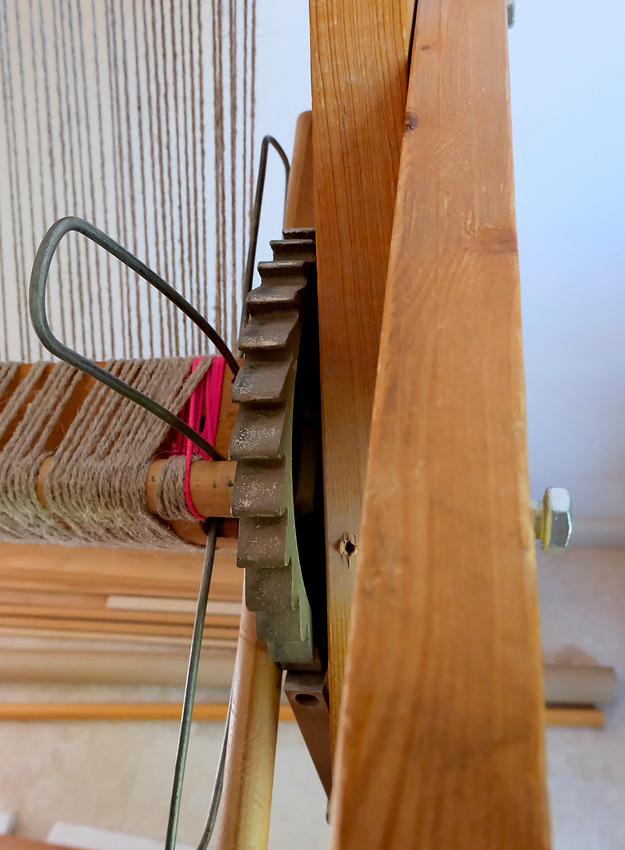 weaving - back ratchet attached to warp beam (loops are Fred's modification)
The next two photographs show the connection between the rollers (in the image here) that raise and lower the heddles (the following photograph), hence the name "counter balance". One set of heddles goes up as the other comes down. This motion is all controlled by Fred's feet on the treadles.
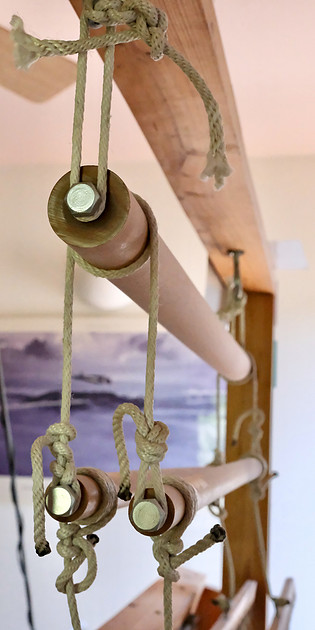 weaving - counter balance
Heddles are ingenious little mechanisms, each holding a piece of yarn or warp that is the skeleton of the weaving. Nylon heddles came with the loom when Fred bought it in 2003, but he has since replaced them with thin but rigid metal heddles. There are 180 heddles through which warp is threaded. The rhythm of the heddles on a loom is pure design in itself.
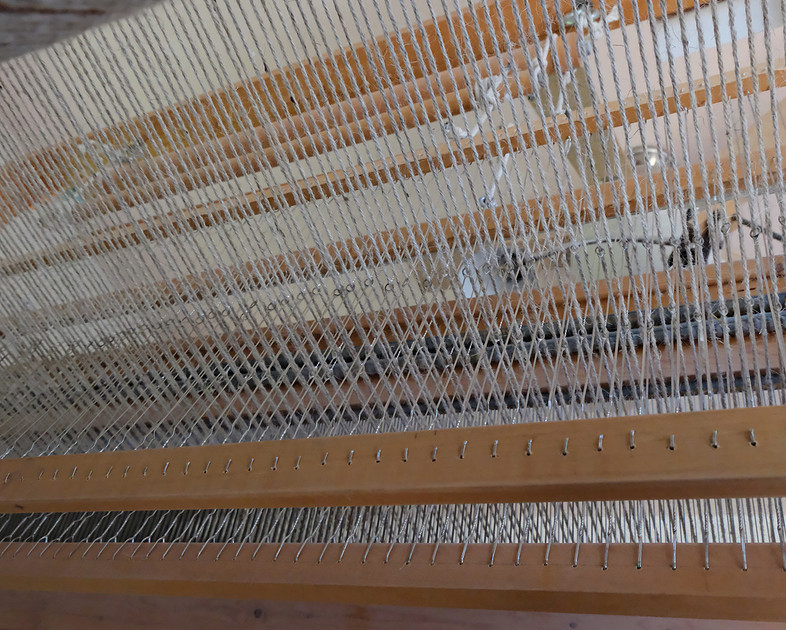 weaving - heddles
In this photograph, a new rug is taking shape on the breast beam or front of the loom.
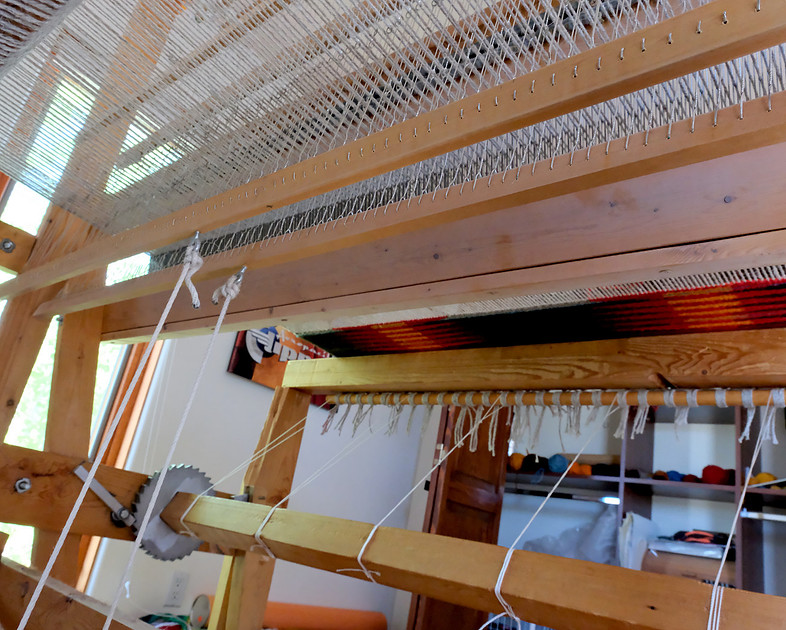 weaving - front ratchet and paul that rotate the cloth beam
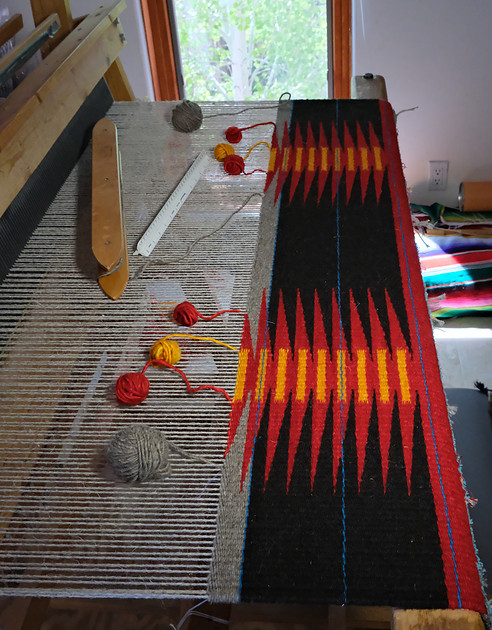 Rug 436 under construction 1
If you had made it this far without doing an eye roll, congratulations! And thank you for persevering. Explaining the Rio Grande Walking loom's "low tech" system is still complicated. But as was written so well by Billy Joel in his great blues piece "Baby Grand", "all it takes is the power in my hands" (and feet, Fred would add).
Thanks to all of you who got in touch during the high tech-imposed hiatus of my blogging, including Gustavo, Louise and Jim, Ann A., Pater, Ingrid, Catherine, Victoria, Terry T., Marilyn G., Steve, and Karren. It won't surprise any of you to know that Fred was instrumental in fine tuning today's blog.
Have a creative and inspiring spring week!
until next Monday
DB
a passion for the image©
Comments
Fred's work in progress is stellar as always.