


the joy of good tools

According to Intelpoint, nearly half of the world's total population is between 20 and 54 years old. Given that number, I suspect some of you reading this may think what I am writing now is unfathomable. But others, because of the times in which we are living, may well identify completely with some of what I say here. It has to do with the inability to buy quality things - in this case a bread knife - when you are young. When my husband and I were married (more ancient history) nearly 54 years ago, we were given a Cutco brand bread knife. It has been with us ever since and used for such disparate things as cutting blocks of snow for an architectural igloo project, and flower stems, to many, many loaves of bread. But sometimes, because of other things being priorities for the money earned in life, you just have to wait to buy the right tool. And when that happens, it is a real joy. Wise people in many different occupations have said "there is nothing like a good tool". And so it goes. We thought it was high time to get a new bread knife, and the online search began. I discovered that the prices of knives varies wildly, due to the quality of steel and how it is forged. Wanting a knife that would last another fifty years, it seemed a Damascus blade (forged by layering and folding different types of steel) would be appropriate. The process of layering and folding leaves patterns that give the blade strength, sharpness, and an edge that retains its sharpness. Not only is it a great tool, it is a thing of beauty. This particular knife is Miyabi brand by Zwilling.
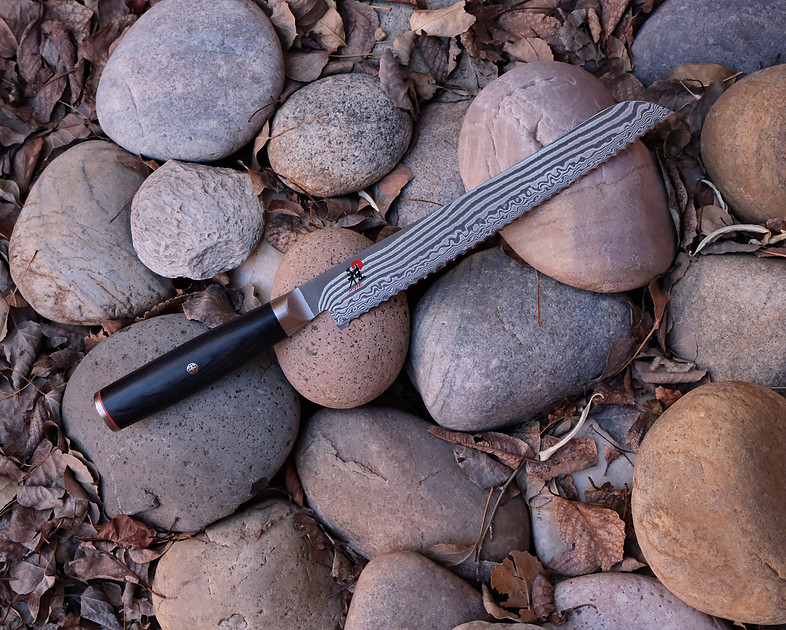
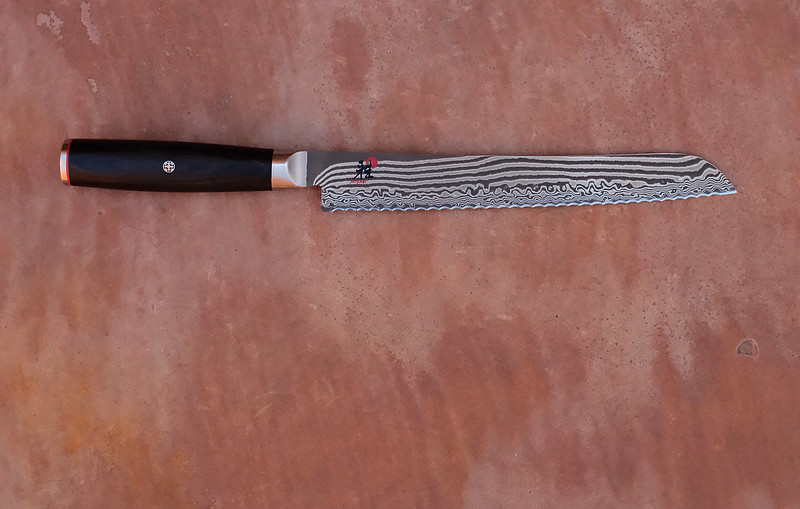
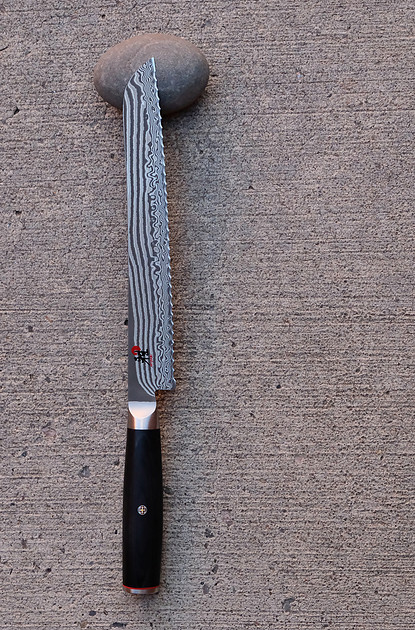
As always, a background can make or break a photograph. There are many choices here. One or two might appeal to you, but each brings something different to the knife.
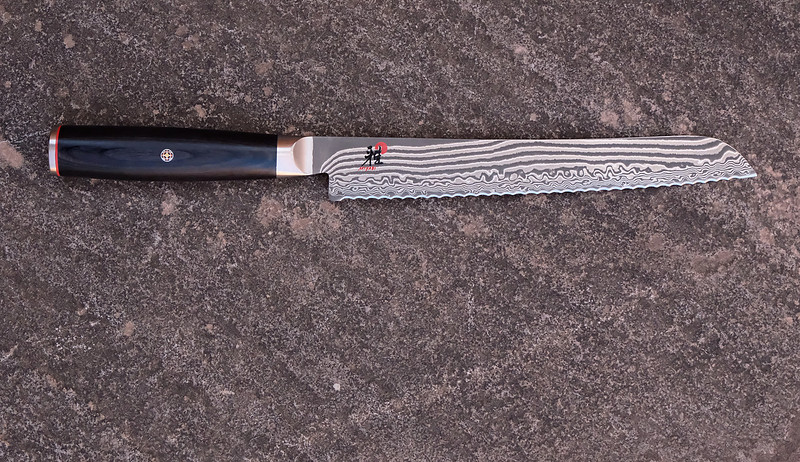 Food - Miyabi bread knife 7
Rocks seems to combine well with the forged steel layers.
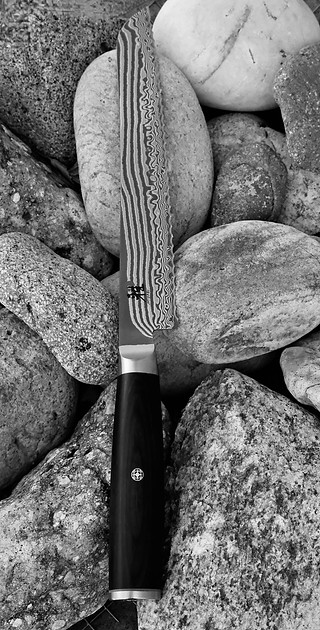 Food - Miyabi bread knife 3
Below is a detail of the blade
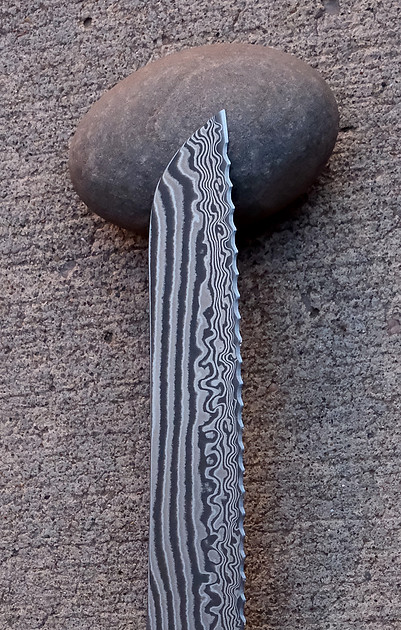 Food - Miyabi bread knife 2
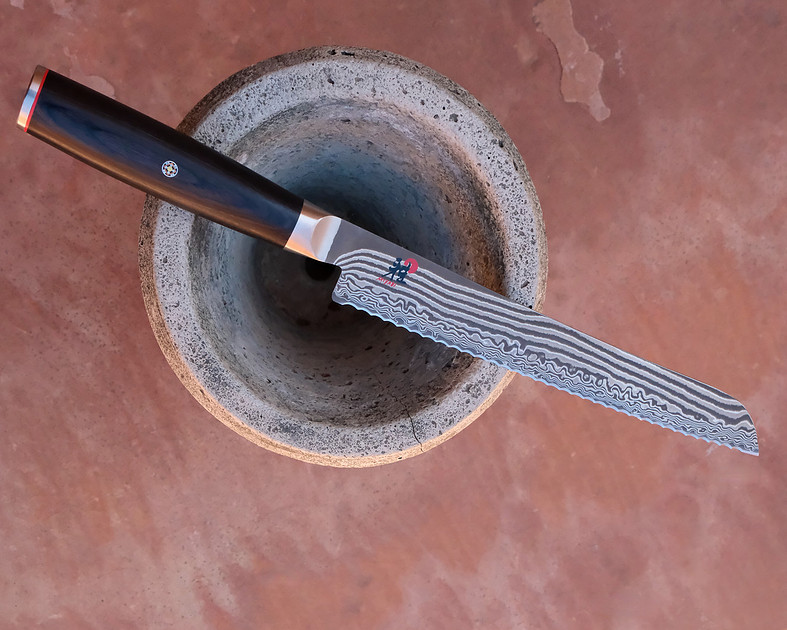 Food - Miyabi bread knife 4
 Food - Miyabi bread knife 6
 Food - Miyabi bread knife 5
 Food - Miyabi bread knife 8
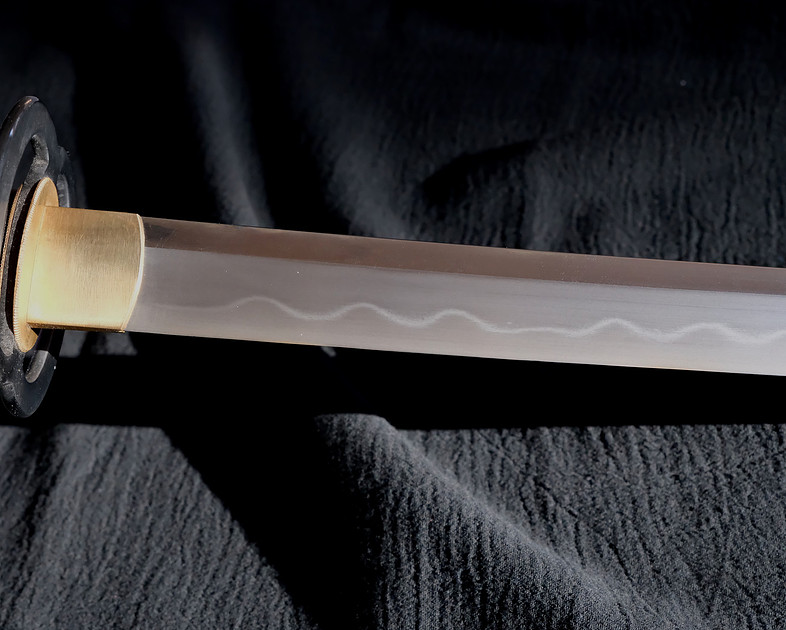
This is a story for another day, but Japanese swords are made differently from Japanese Damascus-edged knives. The sword is made of a flexible steel but its edge is a hard, tempered steel that holds an extremely sharp edge. The "hamon line" which sometimes looks like a wave in the metal, is where the two types of steel are bonded together. There are more than 50 individual styles of "hamon lines" on Japanese swords or "katanas". In the photograph below, you can see the "hamon line".
 Food - Miyabi bread knife/sword 10
There is far too much in the history and traditions of these blades that my few words here barely serve as an introduction. The way the Miyabi knife renders a slice of bread is like nothing I have ever seen. Even the slice itself feels different, confirming there is nothing like a good tool!
Thanks to you wonderful people who commented on last week's blog including Jean & Sam, Paule M., Steve, Mary G., Louise W., Tim, Karren L., Catherine, Marilyn G., Brenda, Geula, Victoria, TTT, Robert U., and Ingrid. It is great to hear from all of you.
until next Monday,
DB
a passion for the image©