


change is coming

Yesterday was the beginning. Meterological spring - March 1-May 31 - is the transition period between the three coldest and three warmest months of the year, according to The Weather Channel. The birds have been behaving as if spring was coming for at least a month, no doubt prompted by nearly non-stop, record-breaking temperatures in the western third of the United States. Somewhere in their beings, they know it is time to mate, lay eggs, and have their first brood. Although this is the Year of the Fire Horse in the Chinese Zodiac, we could call it the year of the robin in our neighborhood. They are avid bathers and once the ice in our two basins melted, there has been a constant stream of robins during the morning hours after sunrise. Because this is a transition period, you will also notice juncos in the first photograph. They are not quite ready to head to the mountains for summer breeding. It is still too cold at elevations over 8,000 feet. So as they do every season, they take their chances with the other birds.
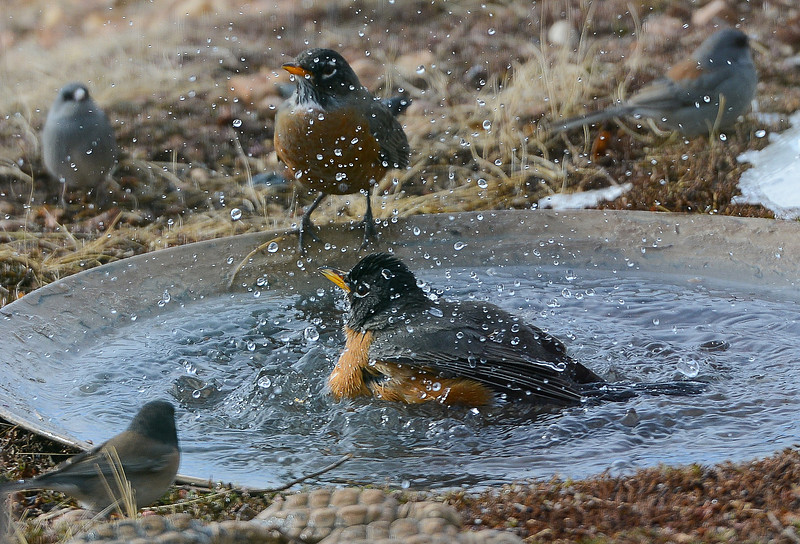
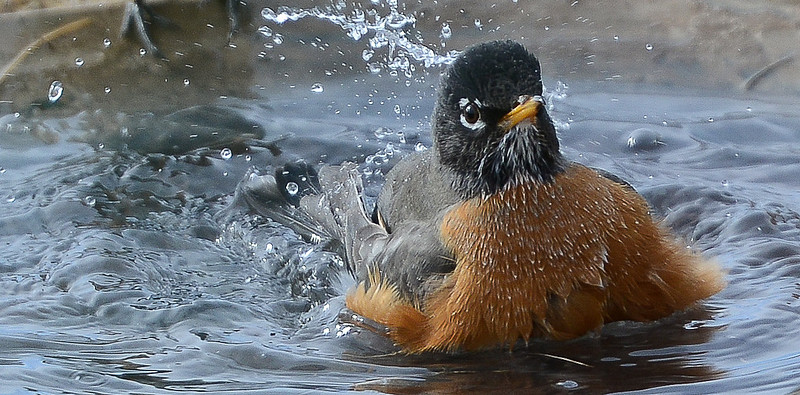
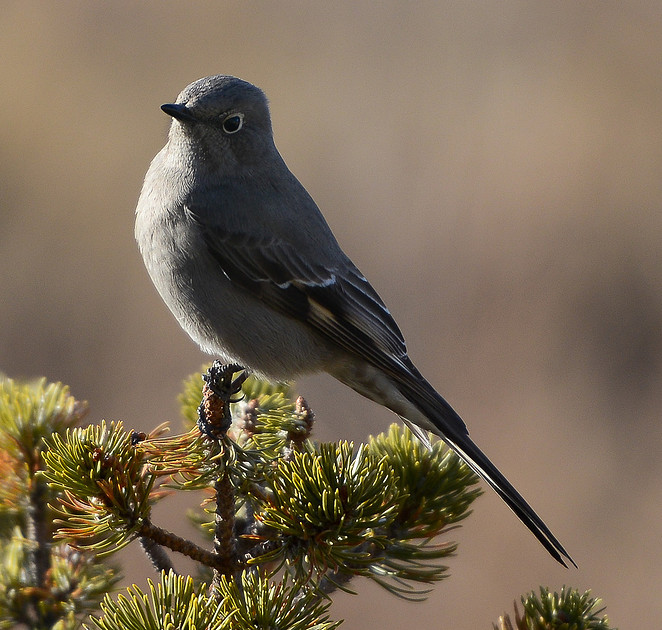
Robins are members of the thrush family, as is the Townsend's Solitaire, shown below.
Because all types of birds live in the greater Santa Fe area, and are part of who we humans are, it is not surprising that we and many others worry about temperature fluctuations and weather patterns as a whole. This is not new. Swedish astronomer and chemist Svante Arrhenius first predicted in 1896 that "changes in atmospheric carbon dioxide levels could substantially alter the surface temperature through the greenhouse effect." (Study.com) As sea levels rise world-wide, many island nations and even cities like Miami, wherein some neighborhoods flood every time there is a full moon, the impact is severe. There is increasing concern about human activity and its effect on weather/climate, and earth systems. In 2007-2008, Bill McKibben and a group of university friends at Middlebury College founded 350.org. "The 350 in the name stands for 350 parts per million (ppm) of carbon dioxide (CO2),[3]which has been identified as a safe upper limit to avoid a climate tipping point." (Wikipedia) Now, in 2026, the parts per million is nearing 430. Several studies of the Thwaites Glacier in western Antarctica have been conducted this season, in order, among other things, to collect data about how the warming ocean temperatures are effecting the glacier. And Bill McKibben continues to be involved in supporting and promoting the use of alternative energies to reduce and even stop the increase of atmosphere carbon dioxide. His latest book, titled Here Comes the Sun, is filled with facts about alternative energy development and usage in the world, as well as possibilities for the future, should the powers that be choose to develop the will to make it work. The birds know change is coming, telling us every day that spring has returned and there are things to do. We'll keep an eye on them and hope you do as well!
Thanks to the people at Nikon for developing a great camera, the D800, and Nikk0r 70-200 mm lens that enable me to take the photographs included here.
My appreciation this morning goes to Marilyn G., Jean & Sam, Terry, Gustavo, Steve, TTT, Louis W., Robert, Veronica, Catherine, Karren & Victoria for writing this week.
until next Monday,
DB
a passion for the image©